Showing posts with label economics. Show all posts

Monday, March 23, 2009

TARP version ... how many has it been again?

Timothy Geithner just announced his new TARP plan: $75BN to $100BN to back $500BN of funds to buy troubled assets. How is this different from the Paulson plan? It is a little more specific. It does leverage private capital. However, in essence, it is the same plan.

Here's how it would work:
  • Let's say a Bank seeks to sell pool of mortgages worth $100;
  • A private auction decides that asset is now worth $84;
  • The private investor and government put up $6 each;
  • They then borrow remaining $72 from government;
  • That loan is guaranteed against any losses;
  • If asset is later sold at higher price, government makes profit and private investor pays back loan and pockets profit;
  • If asset is sold at lower price, government and private investors could lose initial investment.

Am I missing something, or is this really saying:

  • The government and the private investor share equally in all the gains on the entire $100;
  • The government and the private investor share equally in losses till 14% of the market value at the auction, and
  • The government foots the bill for any loss in excess of 14% of the value.

If this is right, it seems like a pretty good deal for investors if the market valuations now are relatively fair.

Krugman, meanwhile, is railing against the plan. I didn't quite follow his logic. His main argument seems to be that the banks will still have lost the money they have, and no amount of taking stuff off the books will help. True. But wouldn't the lack of exposure to further downside risk reduce the inter bank solvency issue somewhat? If Krugman has a reason to believe it won't, he didn't explain it in the article.

Krugman has pointed out that history has shown that some amount of nationalization is necessary.

Couple of points.

  • Firstly, Krugman is right. Some form of nationalization is probably the most effective answer. Government guarantees / nationalization gives people confidence about the solvency of their counterparties. Geithner's plan does that too. However, the degree of confidence inspired by the former is far more and so, I would argue, it is a much quicker fix. Obama, however, needs to weigh the political expediency of nationalization and what it might do to his ability to get other policies passed. So, the fact that we haven't gone there may be just as much a political calculation as an economic one.
  • Secondly, at one point in the article, Krugman writes: "And now Mr. Obama has apparently settled on a financial plan that, in essence, assumes that banks are fundamentally sound and that bankers know what they’re doing." [emphasis added] In so saying, Krugman betrays his political biases and, dare I say it, his naivete. Firstly, how can pouring $500 BN to $1 trillion into the banks in addition to billions already spent suggest that anyone in government think there is anything, fundamentally or otherwise, sound with the banks? But, maybe Krugman is reflecting on the competence of bankers, particularly senior management. In this context, I too have concerns, but is Krugman's idea any better? If we nationalize, who can we replace everyone in these organizations with? Would the bank actually operate better? Yes, they made bad bets, as did everyone else. Does that mean the government will do better? The same government who regulated these industries so 'brilliantly'?

I too am concerned that those who caused the mess are not paying a high enough cost. Having said that, there seems to be a tendency on the left to assume that just because one option is bad, the others are necessarily better. That's a logical fallacy. Krugman and others need to explain why they believe so. Also, nationalization may indeed solve the immediate crisis faster. However, would it really be the long term interest of the nation? Are nationalized banks really better banks?

My guess is that before this is over, a number of these banks and financial institutions are going to be nationalized. AIG and Citi effectively are already. Political expediency aside, more probably would have been already. However, I am not as convinced as Krugman that Obama's reticence to nationalize is necessarily a bad thing.

Tuesday, March 10, 2009

Fun stuff in depressing times

Last week, Jon Stewart decided to rip into CNBC. By the end, I was left with more faith in astrology than the talking heads. It's one of his best segments this year ... hilarious!


Then, Cramer complained. He felt he was taken out of context. Huh? Baiting The Daily Show? Well, here's Jon Stewart's response. Poor Cramer. Why is he allowed on TV again?

On the subject of faith in things that are completely unsubstantiated, like "experts" on TV, here's Joel Stein critiquing the lack of faith in science of liberals. It is hugely entertaining and so very accurate.

Finally, I have been depressed of late of the complete dearth of conservative ideas that address the current economic woes. I was so relieved, therefore, to read David Brooks, finally, critique Obama's policies in an intelligent way. If only conservatives could have adopted such a posture, we might have the response we needed to the crisis instead of the response we settled on, which will probably prove inadequate (I hope I am proved wrong in this).

PS: I must give a shout out to Grain of Sand, who had presciently predicted in November that we would see the type of shocking performance of GM we have witnessed in recent weeks. It might have been cheaper to put the GM staff in the US on a government payroll and start from scratch! Chapter 11 anyone? It's what its there for.

Sunday, February 22, 2009

Should I sell my stocks?

OK. If you are like the vast majority of investors, you are sitting on a much diminished portfolio. The question you may be facing is whether you should hold or sell. Of course, there is no simple answer to this question. You should look at your own portfolio and evaluate the question against your portfolio objectives. However, here are some thoughts to ponder.

In general, most of us are averse to booking losses. So, we don't sell. But, there are reasons to consider selling. Why?

Firstly, if you believed that the price is likely to settle at a value that is much lower for the foreseeable future or if you believe you have better investment opportunities, then selling makes sense. A hundred dollar stock is better sold at $5 than not sold and reduced to zero.

Another view is the tax relief view. Imagine you have a portfolio whose cost was $100. Now the market price of the portfolio has dropped to $20. And, you are subject to a tax rate 15% on your gains and losses on your portfolio. If you sell, provided you have gains to offset your losses, or are permitted to carry forward the losses, you essentially get a tax benefit equal to $12. What does this mean?
  • Well, if the value of the portfolio drops further you have capped your losses at $68.
  • If the value of the portfolio starts rising, we can buy it back at a price less than $20 which would yield a net gain on the transaction, but even otherwise, as long as we buy it buy before the price touches $32, we would essentially protect some of the upside.

Now these calculations don't factor in transaction costs or volatility. All said though, you should consider selling if:

  • The decline in the stock is not part of normal volatility, but part of a prolonged downturn or a permanent decline in value, and
  • There are better investment opportunities, or there is a real risk of the value of the portfolio settling at a level that is much lower than it is currently, or there is a possibility of getting tax relief.

Saturday, February 21, 2009

Worse than the Great Depression?

How bad are things? Well, in some ways its not quite as bad as the Great Depression. Unemployment now is officially around 7%, although including hidden unemployment its probably more like 14%. In the Great Depression, unemployment had touched 25%.

However, in other ways, economists are beginning to point out that it's much worse. Why? Well, for one things are moving faster than anyone imagined possible. Volcker points out that the global fall in industrial production is unprecedented and breaks even the worst doomsday predictions. George Soros points out that there is no end in sight to the financial crisis. The market capitalization of the banking sector now hovers at about what the government has pumped in.

The trouble is that admit that they don't really know what will work. At this point, everyone is trying their best and hoping a lot.

Monday, February 9, 2009

The conundrum of spending

The stimulus package being discussed is probably too small too work say some. This assessment is probably right, or at least, as Galbraith says, faced with the hurricane that is the current economic woes, it would be better to err on the side of excess than moderation. However, the alarming thing is that as people have tried to rack their brains to find ways to spend the extra money required, and they've mostly failed. The fact is, the marginal programs in the spending bill are mostly pork and mostly things that will occur over years, not months. It is unclear whether the President could in fact find an effective way to make the additional spending happen quickly, even if he wanted to. It is almost reminiscent of Brewster's Millions. I suspect Obama will need a separate social program to fill the gap, if he wanted to.

Saturday, February 7, 2009

Crash course

If you would like a quick and interesting view of the economy, particularly how extraordinary today is in the historical context, then this might make interesting viewing.

Essentially, what Chris Martenson is showing is that our current economy is based on growth, and due to the large base, it requires larger and larger absolute increments to sustain. In fact, though, our use of resources is now reaching proportions that are entirely unsustainable. Something has got to give.

It makes interesting viewing. The historical context is absolutely fascinating.

Wednesday, January 28, 2009

US economy bad. Others worse.

While currently the economic woes in the US seem to be worse than in the EU, the IMF predicts that among developed nations, UK will be the worst hit with a contraction of 2.8% in 2009. The EU overall will shrink by 2%. The US will shrink by a "mere" 1.6% - that's roughly $220 BN reduction in the US GDP. Moreover, the IMF has warned that the UK is so structurally unsound that it will remain in debt for 20 years.

Of course, all this pales in comparison to Iceland. Iceland has become the first Western nation to get IMF help since 1976. With 17.1% inflation and outstanding bank debt that is six times its GDP, Iceland is expected to see 9.6% contraction in its GDP in 2009 and at best no growth in 2010. Their Prime Minister has now been forced to resign. Here's a summary of the timeline of key events in Iceland.

Meanwhile, while many developing economies have been ravaged by a combination of the drop in demand from Western economies and the drop in oil prices (a mixed blessing, depending on where you are), they are expected to continue to grow, although their growth will slow substantially.

Where is all that money going?

I have been hearing about the profligate spending that is the Reinvestment and Reconstruction proposal more popularly called the "economic stimulus plan". So, I decided to investigate what they are proposing.

Here's the marked up summary of the proposal from the House Appropriations Committee, and of the tax portion from the house Ways and Means Committee. Obviously, this will change by the time of its passing.

The bad news, for people earning over $75K ($150K for married couples filing jointly), there is very little relief. Let's see if Obama lives up to his campaign promise of lowering taxes for everyone with income under $250K. It all depends on how they phase the relief out.

Here are some highlights of what they are proposing (I have highlighted in blue, those provisions that individuals earning more than $75K per capita would benefit from):

Taxation (these dollar amounts represent the cost over 10 years):

  • $145 BN on a tax credit of 6.2% of earned income phasing out for people earning over $75K ($150K for married couples filing jointly);
  • $4.60 BN on increase in earned income tax credits for very poor families;
  • $18 BN on increasing child credit;
  • $13 BN for college education assistance;
  • $2.56 BN for assistance to first time home buyers;
  • $27 BN for small businesses and acquiring companies;
  • $50 BN for local and state government assistance;
  • $16 BN on renewable energy investments;
  • $4.27 BN on upto 30% tax credit capped to $1500 per annum on energy efficient improvements to existing homes, e.g. heaters, air conditioners, etc.
Spending proposals (not clear how these are expected to be phased):
  • $54 BN on cleaner and more efficient energy (there is a small amount set aside to subsidize energy star appliances);
  • $16 BN on science, technology and Internet access;
  • $90 BN on improving roads, bridges and waterways;
  • $141.6 BN on improving educational facilities and educational programs for poor and under privileged;
  • $24.1 BN on improving healthcare services - particularly their computer systems;
  • $102 BN in unemployment and hunger prevention benefits;
  • $91 BN in preventing lay-offs in the public sector - state and local governments;

A few things to note:

First, the $800 BN number being thrown around is misleading. The cost of the tax proposals is over 10 years. The summary released by the Appropriation Committee on the spending proposals don't explicitly state how these costs will be phased. MSNBC suggested on Hardball that a substantial portion of it will not get spent till Obama's second term.

If we assume that the tax benefits would more or less be uniform over the 10 years or even skewed a little to later years, assuming economic growth and that 80% of the spending would be over the next one or three years, this would mean that the actual impact over the next two years of the stimulus is probably more like: $450 BN - $550 BN. Worse, over $100 BN is actually just preventing cut backs in government spending. So, it isn't incremental spend. The incremental spend is more like, $350 BN - $450 BN. Worse, this is spread over two to three years, which means that the immediate impact is likely $150 BN to $200 BN, which is just about 1.5% of GDP. Given the expected contraction in GDP is 1.6%, this seems low to spur growth. It'll just about cover the gap.

In terms of who gets the benefit, if you ignore timing differences, here's the allocation:

Tax cuts for individuals: 20%
Education: 19%
State and local governments: 18%
Underprivileged: 13%
Basic infrastructure: 11%
Renewable energy: 9%
Small businesses: 3%
Healthcare: 3%
Science and technology: 2%

Unfortunately, most individuals won't see most of these benefits for a while yet, whereas the spending increases will take near immediate effect.

Monday, January 26, 2009

On the economic recovery plan etc.

For those who are struggling with history of recession solutions ranging from Supply Side economics to Keynesian economics, this is an excellent brief map of the history of recession management in the US since the 1960s. Kennedy was actually the first President to consciously try a Keynesian solution to a recession. The other President to use it extensively was Reagan (in effect, although not in intent).

I don't know about you, but I am increasingly exasperated by the certitude with which talking heads on TV make assertions reiterating partisan rhetoric on the "economic rescue plan". Why do experts of all hues insist on peddling opinions as fact, despite the complete lack of evidence? Why not reproduce the facts in an intelligible way and leave it for viewers to decide? The truth is they don't know the answers, despite their protestations to the contrary.

Here's Warren Buffet on the topic of the economy. I've reproduced one part of the interview for you below:
Q: "... But there is debate about whether there should be fiscal stimulus, whether tax cuts work or not. There is all of this academic debate among economists. What do you think? Is that the right way to go with stimulus and tax cuts?"

Warren Buffet: "The answer is nobody knows. The economists don’t know. All you know is you throw everything at it and whether it’s more effective if you’re fighting a fire to be concentrating the water flow on this part or that part. You’re going to use every weapon you have in fighting it. And people, they do not know exactly what the effects are. Economists like to talk about it, but in the end they’ve been very, very wrong and most of them in recent years on this. We don’t know the perfect answers on it. What we do know is to stand by and do nothing is a terrible mistake or to follow Hoover-like policies would be a mistake and we don’t know how effective in the short run we don’t know how effective this will be and how quickly things will right themselves. We do know over time the American machine works wonderfully and it will work wonderfully again."

Couldn't agree with him more.

On a different note, the complexity of the economic woes has been excellently summarized by Samuelson in his Op-ed piece. As Samuelson astutely points out, the US is facing three separate economic crises:

  • A decline in consumer spending. Consumer spending is 70% of the US economy. With the wiping off of over $7 trillion in personal wealth, people just aren't spending any more.

  • A breakdown of the financial system. Financial institutions just aren't lending, and without credit, there is little chance of growth. Part of this has to do with ravaged balance sheets due to mounting losses - the target of the TARP. Part of this has to do with the loss in confidence in several market making derivative and other financial instruments. And, a major part has to do with the uncertainties around people and companies' income potential and the consequential difficulty in developing appropriate lending criteria.

  • Slowdown in the rest of the world: This is no longer just a US crisis. The rest of the world is slowing down. While a much smaller part of the US economy, the slowdown in the rest of the world could thwart attempts to kick start growth in the US.

Finally, let's clear up the confusion between the New Deal and Keynesian economics.

Although, Maynard Keynes did advise FDR he was neither the primary advisor to FDR nor the architect of the New Deal. Keynes inter alia advocated massive deficit spending and government intervention to ensure full employment as a means of reversing the depression. As this brief history of the New Deal in Wikipedia suggests, FDR didn't exactly do that. In fact, the US was very conservative in its approach and even tried to return to balanced budgets in the mid-1930s, with disastrous consequences. It is true that many of the structures that regulate today's economy were set up or restructured during the New Deal. However, as an example of Keynesian economics, the New Deal provides at best mixed data that can be sampled to buttress claims by both sides of the argument. The equivalence of the New Deal with Keynesian economics therefore is somewhat misguided.

Friday, January 16, 2009

A breakdown in classical economics

Very nice article by David Brooks, neatly summarizing the breakdown in classical economics and why the answers to the current crisis may lie more in behavioral economics.

Saturday, December 27, 2008

Fear of cliffs

If you expected an article about the white cliffs of Dover, you will be sorely disappointed. I am referring here to cliff events in the context of the economy.

In recent days there have been frantic efforts by many in the government egged on by many reputed economists including advocates of free markets to intervene in the market and prop up failing institutions. They have intervened, but seemingly to little effect. What's going on? Why is there such a panic?

Underlying the theory of free markets is an assumption that free markets, even when not perfectly efficient, are mean reverting. This is why advocates of non-intervention speak of "market correction". The idea is that while there can be a distortion in value for a time, ultimately everything will automatically revert to a true value. Of course, this view assumes the existence of such am invariant 'true value'.

There is, however, a more interesting set of theories that have been evolving that postulate that natural systems, including financial markets are chaotic. This means, that while they may occasionally appear to be mean reverting, there is no reason that they should revert to a mean. Instead, even small changes can have extremely magnified effects resulting in a different level in the long run. In such systems, small changes can have huge, often catastrophic effects. Examples of such chaotic changes are literally the straw that breaks the camel's back or the butterfly effect. In this view, there are times when a financial system like the economy can stand at a brink, where on one side, it seems unwell but curable, and on the other it faces complete ruin.

Let me illustrate with an example.

In the early part of this decade, as Enron devolved into a financial debacle, disclosures made to ratings agencies put the ratings agencies in a quandary. On the one hand, if they continued to maintain the same credit rating, then it was possible that in the interim time the company could find a way to pull itself out of the mess. On the other hand, if they reduced the rating, then it would automatically trigger a series of obligations that would hinder Enron's ability to borrow. The resulting mess would lead to further downgrades, and so on, quickly reducing Enron to junk bond status.

This was an example of a credit cliff. It's a situation where a small change in the conditions, i.e. Enron's credit rating, could push it over a cliff.

Two things to note.
  • Firstly, the cliff was characterized by the value was driven belief that was ultimately self referential - i.e. it had value because people believed it had value. It was solvent as long as people believed that it was and would continue to be solvent.
  • Secondly, the fiction was ultimately unsustainable.
How does this relate to the US economy? Well, you see, all those panicking economists are actually worried that the US economy is at such a cliff. The value of US companies, US markets, US debt and ultimately the US economy is ultimately dependent entirely on everyone's belief in the US economy and its ability to survive this crisis.

The problem is that the US economy as a whole is over-leveraged and over valued. The US need a HUGE amount of money to dig itself out. The only way for the US to get that money is that everyone continues to believe in the US.

With huge foreign holdings of US debt and US investments, if people suddenly started to doubt the US and started to disinvest, then the US economy could, in theory, collapse. The problem is that unlike the mean reverting view, in this view, the new equilibrium would leave the faith in the US economy so damaged that it would permanently destroy the US economy's value, and the US would never completely recover.

The Fed's experiment with Lehman caused a crash that has everyone spooked. They won't try it again. No other large US brand name can be allowed to fail. What the US government, Fed and all those illustrious economists are hoping is that if they can just hold on long enough, things will get better. They are banking on the assumption that it's in no one's interest to let the US fail. The alternative is a complete collapse of the US economy.

Are we really at such a cliff? Who knows? But you don't really want to find out by stepping off the ledge, do you?

However, note that all these interventions maintain a fiction. They keep you on the right side of the ledge. They don;t get you further away from the ledge. In fact, in some ways, they lift you up a bit, making the fall, if it comes, all the worse. So long as there is no catastrophic collapse of the economy, you could say these measures are working. But you are still at the edge.

To fix things, we still need to fix the underlying problem - asset price inflation. There are only two solutions. Either let the asset prices deflate. Or, let them stagnate until the value increases to the price. Neither is attractive. Both take time, maybe years. And, remember the second lesson from Enron is that ultimately the fiction can only maintained for so long. Let's hope the creditors of the US economy are more patient.

On the bailouts ...

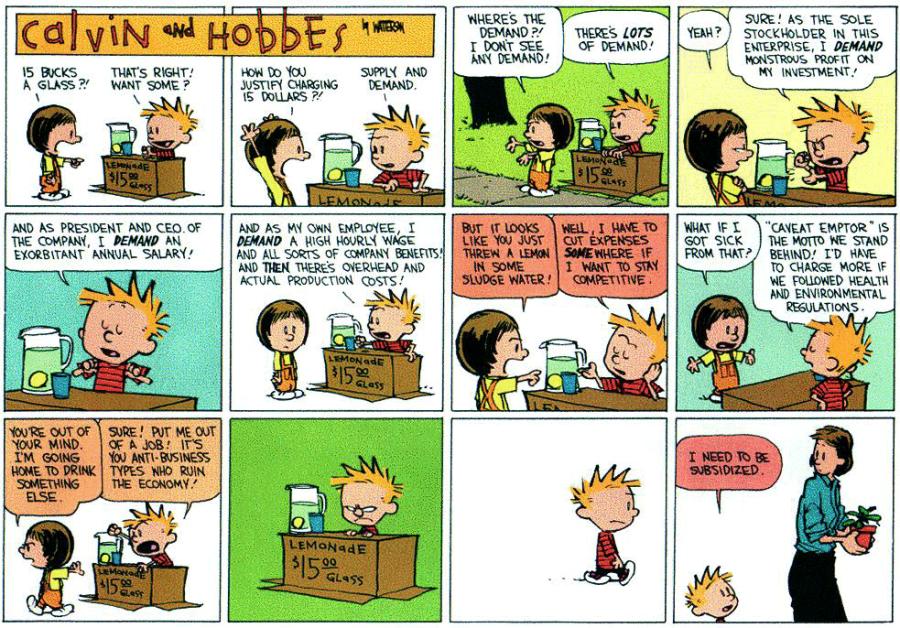
Dhakks and I were having a discussion recently on the bailouts, and I was almost inspired to write a lengthy piece explaining my views. But then I came across this Calvin and Hobbes strip that does it so much better. Enjoy! (click on the strip to expand)


Sunday, October 19, 2008

Could this crisis have been foreseen?

Many have commented that this economic crisis took the world by surprise and no one really understood the gravity. This link has a compilation of people who predicted part of all of what has unfolded in this economic crisis.

However, for me the more compelling one is The Economist. As readers of the magazine would be aware, that publication has been warning of this since 2007. Don't believe me, see the covers from 2007 below:


PS: Many of the prescient theorists who warned of impending crisis, such as Joseph Stiglitz and Warren Buffet, are Obama's advisers. Others like, Paul Krugman, have endorsed Obama and are on the advisory panels for key Democrats, such as Hillary, who would be involved in any final rescue effort.

Saturday, October 18, 2008

The sky is falling!

Volcker, the former Fed Chief says the US is in recession. Reactions to the recession forecasts have been strong. Gloom abounds. People are running around panicking like chickens. Conservatives are making gloomy predictions about how this will play out. In a recent article on the economy, David Brooks makes one such attempts at soothsaying. He predicts that Obama will ride this tide to a liberal overreach which will be followed by a conservative backlash. Very plausible.

Meanwhile, another interesting philosophical debate wages between liberals and conservatives, about whose view of the economy is right.

The liberals are crying vociferously that this means the end of free markets and the GOP approach to economics. They say it proves the GOP theories failed.

Meanwhile, the Libertarian fiscal conservatives are shouting that Bush is leading America to socialism, as illustrated this article on Ron Paul's economic adviser railing against Bush's socialism.

In a recent article on CNN, Jeffrey Miron, makes his case for free marketers, and waxes eloquently on why bankruptcy not bailout is the answer. Essentially, he points out that the bailout will reward the worst excesses and thereby facilitate the return of such excesses. By letting banks fail, you ensure that the system self corrects itself to a state where everyone is more prudent. You won't get good behavior, if you bail out the offenders every time they slip up. He also suggests that efforts to intervene will either distort the market or fail completely. On the whole, he advises doing nothing.

Others though are less sanguine. George Soros and others are pointing out that the free market system assumes that markets are self correcting. However, Soros suggests that the evidence is that markets are not. That to be self correcting they need regulations that ensure that the players play by the rules.

Others like Sloan point out that what is happening is just normal market correction and the cries of socialism or calls for re-examination of the whole structure of government are premature and unwarranted.

Meanwhile, Nassim Taleb is challenging one of the fundamental tenets of derivative pricing and thinks their Nobel prize should be revoked. Taleb's explanation is that the formula used by Merton, Black and Scholes was a widely known formula for Markov chains, and they merely applied it to economics. Further, he points out that the data shows that the Black Scholes approach is fundamentally wrong, as it assumes the distribution of rate changes is normally distributed, when in fact, the data shows that there is a significantly higher probability of extreme events than predicted by Black-Scholes.

So, which view is right? From a Scientific perspective, all the theories have merit. For instance, Supply-side and Keynesian economics both work. There is mountains of evidence that both do. There is mountains of evidence that blind adherence to one or the other doesn't. In the Asian crisis in the mid 1990s, Malaysia and Thailand went in opposite directions, and the results for their economies was much the same. So, net net, the economic theories seem a wash.

The reason of course has to do with the fact that these debates fail to realize two essential elements of economic theory. The first is that while economic theory can help frame up the debate about what could happen if you did A vs. B, it says nothing about which is better. What would happen is a scientific question and amenable to testing, whether it is good is a moral question and a choice.

For instance, raising taxes indefinitely would in fact reduce growth. However, not providing services like social security, defense, basic infrastructure, etc. for the economy, could be devastating for many people. So, taxes are necessary, too much is not. There is of course a trade-off. How much is good? The answer is how important is protecting people, providing healthcare etc. vs. making lots of money? By the way, it can be shown that at a certain point, the infrastructure will fail to the point that incremental tax breaks will no longer generate growth, but will retard growth.

The choice therefore is a moral one.

In a pure free market system, the length of the recession can be very long and the interim downward spiral would punish a lot of market participants. The people hardest hit would be those at the fringes, i.e. the poor and the middle class. If things were allowed to play out, ultimately it might correct, but not before wreaking devastation on huge numbers of people. The reason pure free market economics has never been applied in full is that whenever things get bad, the usually powerless populace reacts badly, voting out or throwing out the government and demanding change. The longer free market approaches are tried in bad times, the more political instability it creates.

Supply side economics works too. It enriches richer people first and prioritizing the plight of poor people lower. Ultimately everyone benefits. Given the incentive to rich, means that powerful market participants invest heavily, driving investment and growth. However, in general, while the benefits do trickle down, in most economies that have tried this, income disparities have grown, not shrunk. Ultimately, what that means is that poor people have substantially lower risk tolerance and richer people (i.e. people who drive the economy) have substantially higher. Ultimately, when the people in power can no longer empathise with people who are not, it can lead to very stupid risks - i.e. bubbles.\

Keynesian theories work too. The problem with them is that the allocation of money by the government is almost always a political decision and not an economic decision. Also, governments are notoriously bad at cutting back in good times. The effect of the two is that Keynesian intervention often creates huge market imbalances, lower productivity, higher structural unemployment (usually because giveaways reduce the incentive for people to go and find work), and significantly greater long term inflationary risk - because of government's inability to cut back. On the other hand Keynesian approach substantially reduces the impact on poor and middle class, and minimizes the risk for them.

Properly regulated and governed, in all three you can avoid the worst excesses.

These are no where near complete analysis. However, the larger point is that we need to choose what effect is desirable and choose the best tools to achieve it. No amount of examination of the tools can reveal the ideal goal.

This brings us to the second fallacy. As Soros points out, all human systems are flawed. And every decision has a measure of good and a measure of not so good. The good and the not so good can be concentrated on particular sections of the economy or spread around. Over time, the dogmatic continuation of any philosophy will create sufficient accretion of the not so good aspects where the good of that policy no longer offsets it. At that point, you need a different solution.

This brings me back to David Brooks' article. In the article, David Brooks describes the effect of an Obama government, and predicts that it will ultimately result in the revival of conservatism. It's not very clear whether he wants to pass judgment, but there is just a hint that conservatism in its purest form is the better philosophy. However, in describing the effect, Brooks has explained something else very eloquently - that governments in democracies are also market participants. The swing from liberalism to conservatism in a sense is the attempt by the market to find a balance between the evils of competing approaches. The longer we double down on one or the other philosophy, the more the imbalance it creates, and the more the need for a change in direction. So, what Brooks, describes a market place where the competing ideas seek balance and equilibrium. In this sense, democracy is enabling the free market to help drive the moral choices we make.